


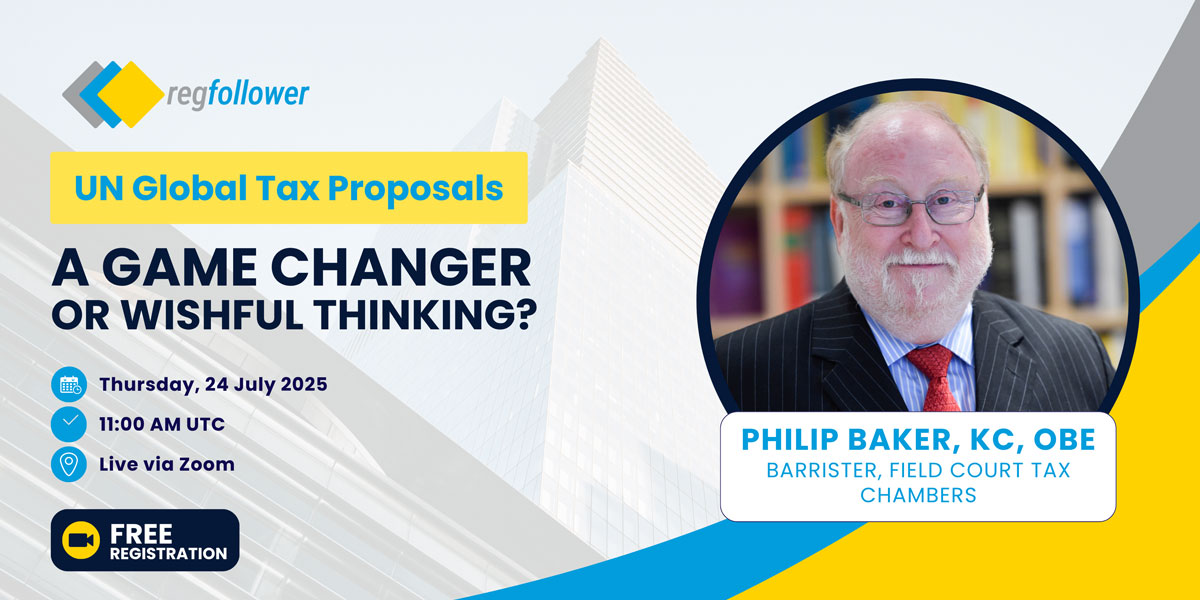
Regfollower debuted its official podcast, Regtalks, live on 24 July 2025, with a compelling discussion with Philip Baker OBE KC, one of the world’s leading experts in international tax law.
He unpacked two UN initiatives: the Framework Convention on International Tax Cooperation, which aims to democratise international tax governance toward a more inclusive system, and the Fast Track Instrument (FTI), designed to streamline treaty revisions and empower source-based taxation.
With decades of legal practice, international advisory experience, and academic distinction, Philip offered his unique perspective on:
- Key differences between UN tax proposals and OECD-led initiatives
- Factors driving the shift in global support from OECD to UN tax leadership
- Feasibility of an UN-led convention succeeding where others failed
- Upcoming developments to monitor for tax professionals and policymakers
For government or business tax professionals, this is a rare opportunity to hear from one of the sharpest minds in the field.
Additional questions from the audience
We had audience members join us from around the world. Due to time constraints during the taping, we were unable to address all of the questions submitted. However, Philip responded to the remaining questions after the session concluded.
Q1 I’ve heard that the UN’s proposals include a global wealth tax. How realistic is that?
At present, the proposed two early protocols to the UN Framework Convention do not include a proposal for a wealth tax. This is something that the new membership of the UN Committee of Experts might take up when they meet in October. There is strong support, especially in Latin America, for some tax proposals to reduce the growing inequalities of wealth. Whether a wealth tax is a feasible or desirable option remains to be seen.
2Q Is there any point in a “framework” convention to deal with these issues – isn’t it just like an agreement to agree?
If the UN Framework Convention established a truly inclusive, global body to discuss issues of concern, it might be worthwhile. However, at present, the prospects for achieving such an outcome are not high. The mistake was probably in choosing the format of a framework convention, plus the unwillingness of some countries to compromise on key issues. As things stand, any convention may not prove to be more than an alternative to the OECD for some Global South countries, but there are still two years to go to see if anything more constructive results.