

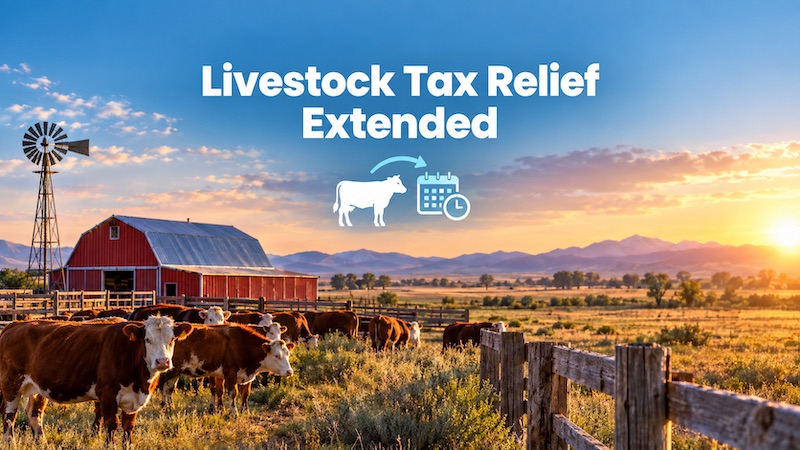
The US IRS has extended tax relief for farmers and ranchers in drought-affected areas, allowing eligible producers to defer gains from forced livestock sales and extending the replacement period from two to four years.
The US Internal Revenue Service (IRS) issued new guidance on tax relief for farmers and ranchers across the country who sold or exchanged livestock due to severe drought on 15 September 2026. The extension allows affected producers to defer taxes on gains from forced livestock sales and take additional time to replace their animals.
Who qualifies for the relief
Eligible farmers and ranchers must meet two conditions: the livestock must have been held for draft, dairy, or breeding purposes, and the sale or exchange must have occurred in an area with a federal drought designation. Livestock raised for slaughter or held for sporting purposes do not qualify for this relief. Sales of poultry also fall outside the program’s scope.
Timeline for livestock replacement
The standard tax rule requires farmers to replace sold livestock within two years. Notice 2026-54 extends this replacement period to four years for eligible producers in drought-affected areas. If drought conditions continue, the IRS can extend the deadline further.
The extended deadline also includes a provision that gives farmers until the end of their first tax year after the first drought-free year to complete the replacement. For producers whose original four-year window was set to close at the end of 2026, this means they now have until the end of their next tax year to replace the livestock.
Geographic scope and determination
The relief covers 49 states, the District of Columbia, Puerto Rico, and other designated areas. Qualification depends on whether the region received a federal drought designation during the 12 months ending 31 August 2026. The National Drought Mitigation Centre identifies regions experiencing exceptional, extreme, or severe drought between 1 September 2025 and 31 August 2026.
IRS Chief Executive Officer Frank J. Bisignano stated that the extension provides support to farmers and ranchers facing ongoing drought hardship. Full details and examples appear in Notice 2006-82, available on IRS.gov.